Table of Contents
ToggleA properly functioning stove range hood isn’t just another kitchen appliance, it’s your first line of defense against grease buildup, cooking odors, and moisture damage. Without adequate ventilation, steam condenses on cabinets, grease coats every surface, and smoke lingers long after dinner’s over. Yet many homeowners either skip the hood entirely or settle for an underpowered unit that barely moves air. Whether you’re renovating an outdated kitchen or upgrading a builder-grade model, understanding how range hoods work and what to look for will save you from costly mistakes and years of regret.
Key Takeaways
- A kitchen range hood prevents grease buildup, cooking odors, and moisture damage by capturing airborne particles before they spread throughout your home and damage cabinetry, paint, and HVAC systems.
- Calculate the correct CFM (cubic feet per minute) rating using the Home Ventilating Institute formula: 100 CFM per linear foot for wall-mounted hoods and 150 CFM per linear foot for island installations, plus 1 CFM per 100 BTUs for gas ranges.
- Size your range hood to extend at least 3 inches beyond each side of the cooktop; a 30-inch range requires a 36-inch hood minimum, and undersized units allow grease-laden air to escape around the edges.
- Ducted (vented) hood systems are more effective than ductless alternatives because they remove heat, moisture, and grease particles from your home, while ductless systems require charcoal filter replacements every 3 to 6 months and don’t eliminate cooking byproducts.
- Install rigid or semi-rigid metal ductwork with the shortest, straightest path possible, since every 90-degree elbow reduces airflow by approximately 25 feet of equivalent straight duct and can compromise ventilation performance.
- High-CFM range hoods above 400-500 CFM may trigger makeup air requirements in tight, energy-efficient homes to prevent negative pressure and backdrafting in furnaces or water heaters, so check local building codes before installation.
What Is a Kitchen Range Hood and Why You Need One
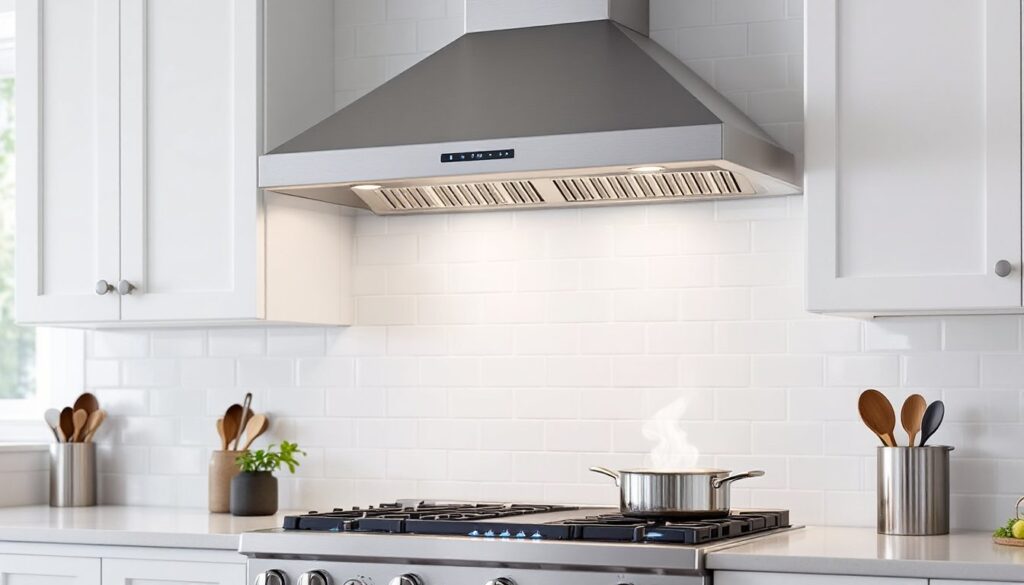
A kitchen range hood is a ventilation unit mounted above your cooktop or range that captures airborne grease, smoke, steam, and odors before they spread throughout your home. The basic components include a canopy or housing, one or more fans (measured in cubic feet per minute or CFM), filters (metal mesh or baffle-style), and either ductwork leading outside or a recirculating system with charcoal filters.
The hood’s job goes beyond comfort. Cooking generates particulates, tiny grease droplets that coat surfaces and infiltrate HVAC systems. Over time, this buildup damages cabinetry finishes, discolors paint, and creates a fire hazard if it accumulates in ductwork or on range surfaces. Steam from boiling water raises indoor humidity, which can lead to mold growth in poorly ventilated kitchens.
Building codes in many jurisdictions now require mechanical ventilation in kitchens, especially for gas ranges. The International Residential Code (IRC) mandates that kitchens have either natural ventilation (operable windows) or mechanical ventilation capable of exhausting at a minimum rate. Check local requirements before finalizing your design, some areas require a hood for any cooktop over a certain BTU output.
Beyond code compliance, a quality overhead range hood improves indoor air quality. Gas burners produce carbon monoxide and nitrogen dioxide: electric ranges still generate smoke and volatile organic compounds (VOCs) from oils and proteins. An effective ventilation system removes these contaminants before they’re inhaled or settle into fabrics and furnishings.
Types of Kitchen Range Hoods Explained
Wall-Mounted and Under-Cabinet Range Hoods
Wall-mounted hoods (also called chimney-style hoods) install against a wall above the cooktop, with ductwork concealed inside a vertical chase or chimney. They’re the most common choice for ranges positioned against a wall and come in widths from 24 to 60 inches. Most feature stainless steel, painted metal, or glass canopies with adjustable chimney extensions to fit ceiling heights from 8 to 10 feet or more.
Under-cabinet range hoods fit beneath existing cabinetry, making them ideal for kitchens where cabinet space is tight. These models are typically 30 or 36 inches wide and depth ranges from 16 to 20 inches to align with standard cabinet dimensions. They’re less expensive and easier to install than wall-mounted units but often have lower CFM ratings due to compact fan housings.
Both styles use either internal blowers (fan housed inside the hood) or external blowers (fan mounted in the ductwork or outside the home). External blowers reduce noise inside the kitchen but complicate installation and cost more upfront. According to tests by Good Housekeeping, internal blower models rated at 400 CFM or higher perform adequately for most residential cooking needs.
Installation requires locating wall studs for secure mounting, most hoods weigh 30 to 60 pounds and need at least two 3-inch lag screws into studs or blocking. If your wall framing doesn’t align with the hood’s mounting bracket, install a horizontal 2×4 or 2×6 backer board between studs before hanging the unit.
Island and Downdraft Range Hoods
Island hoods suspend from the ceiling above cooktops positioned away from walls. Because they lack the wall’s natural capture area, island hoods need higher CFM ratings, typically 50-100 CFM more than a comparable wall-mounted unit. They also require ductwork routed through ceiling joists and either up through the roof or horizontally to an exterior wall.
Ceiling joist placement dictates where you can run ducts. If joists run perpendicular to your duct path, you’ll need to box out the ductwork below the ceiling or cut and header joists (which may require an engineer’s approval for load-bearing considerations). Round 6-inch or 8-inch rigid metal duct works best: avoid flexible duct, which creates airflow resistance.
Downdraft vents are a niche solution for island or peninsula cooktops where overhead installation isn’t feasible. These units rise from behind the cooktop when in use and pull air downward through ductwork beneath the floor. They work reasonably well for electric and low-BTU gas burners but struggle with high-heat cooking because heat rises, fighting natural convection limits their effectiveness.
Installing a downdraft system requires access below the floor (crawlspace or basement) to route ductwork. If you’re on a slab foundation, this typically isn’t an option. Downdrafts also have lower CFM ratings than overhead hoods, usually topping out around 300 to 500 CFM.
How to Choose the Right Size and CFM Rating
The stove hood range should extend at least 3 inches beyond each side of your cooktop for effective capture. For a 30-inch range, choose a 36-inch hood: for a 36-inch range, a 42-inch or 48-inch hood is ideal. Undersized hoods allow grease-laden air to escape around the edges, defeating the purpose of ventilation.
CFM (cubic feet per minute) measures how much air the fan moves. The Home Ventilating Institute (HVI) recommends 100 CFM per linear foot of cooktop for wall-mounted hoods and 150 CFM per linear foot for island installations. So a 36-inch (3-foot) wall range needs at least 300 CFM: the same cooktop on an island needs 450 CFM.
Gas ranges have another consideration: BTU output. A common guideline is 1 CFM per 100 BTUs. If your range produces 40,000 BTUs total across all burners, you need a minimum of 400 CFM. High-output ranges (60,000+ BTUs) often require hoods rated at 600 to 900 CFM, which may trigger makeup air requirements, see below.
Noise is the trade-off for power. CFM ratings correlate with sound levels measured in sones. Most residential hoods operate between 3 and 8 sones at full speed: anything above 6 sones becomes intrusive during conversation. Multi-speed controls let you run lower CFM (and quieter operation) for simmering and ramp up for searing or frying.
One often-overlooked factor: makeup air. When you exhaust 400+ CFM from a tight, energy-efficient home, you create negative pressure. This can cause backdrafting in furnaces or water heaters (pulling combustion gases into living spaces) or make exterior doors hard to open. Some jurisdictions require a makeup air system, typically a dampered duct bringing outside air into the kitchen, for hoods rated above 400 or 500 CFM. Check with your building department and HVAC contractor before buying a high-CFM unit.
Installation Options: Ducted vs. Ductless Systems
Ducted (vented) hoods exhaust air outside through metal ductwork, removing smoke, moisture, and grease particles from your home. This is the most effective setup and the only option that truly eliminates cooking byproducts. Duct runs should be as short and straight as possible, every 90-degree elbow reduces airflow by roughly 25 feet of equivalent straight duct, and longer runs require higher CFM to compensate.
Use rigid or semi-rigid metal duct, not flexible foil duct, which traps grease and violates most fire codes for range hood installations. Round ducts have less friction loss than rectangular, but rectangular may be necessary to fit within wall or ceiling cavities. The Home Ventilating Institute recommends 6-inch round duct for hoods up to 400 CFM and 8-inch for 600 CFM or higher.
Terminate the duct through an exterior wall or the roof using a proper vent cap with a backdraft damper to prevent outside air from entering when the hood isn’t running. Wall caps are easier to install and maintain than roof caps, which require flashing and are prone to leaks if not done correctly. If you’re not comfortable working on a roof or cutting through siding, hire a contractor, water intrusion from improper flashing causes far more damage than the cost of professional installation.
Ductless (recirculating) hoods filter air through metal grease filters and activated charcoal or carbon filters, then return it to the kitchen. They’re a fallback for rentals, condos with restrictions, or homes where ductwork installation is prohibitively expensive. But they don’t remove heat or moisture, and charcoal filters need replacement every 3 to 6 months depending on use.
Ductless models are easier to install, no ductwork, no exterior penetrations, just mount the hood and plug it in. But effectiveness is limited. Experts at Bob Vila note that ductless systems reduce odors but do little for smoke or grease unless filters are changed religiously. If you cook frequently or use high heat, a ducted system is worth the added complexity.
Some over range vent hood models offer convertible installation, with adapters to switch from ducted to ductless. This flexibility helps if you’re not sure about duct routing during initial installation, but ducted mode will always outperform recirculating.
One final note on electrical: most range hoods require a dedicated 120V circuit. If your kitchen’s existing wiring is maxed out, you may need an electrician to run a new circuit from the panel. This is straightforward work but adds cost and requires a permit in most areas. Don’t tap into the range’s 240V circuit or an overloaded general-use circuit, it’s a code violation and a safety risk.
Conclusion
Choosing the right kitchen range hood comes down to matching CFM to your cooking style, ensuring proper sizing for your cooktop, and committing to ducted installation whenever possible. Whether you’re installing a wall-mount, under-cabinet, or island model, the upfront planning, stud location, duct routing, electrical, prevents headaches later. For more inspiration and appliance advice, resources like The Kitchn offer real-world reviews and design ideas. With the right ventilation in place, your kitchen stays cleaner, healthier, and more comfortable for years to come.