Table of Contents
ToggleThat Bosch dishwasher humming away in your kitchen is an impressive piece of German engineering, until it throws an error code at you at 9 PM with a sink full of dishes. Or maybe you’re trying to figure out if that weird grinding noise is normal, or why your dishes are coming out cloudy. The answer to nearly every question, quirk, and hiccup? Your dishwasher’s manual. It’s not the most thrilling read, but it’s packed with model-specific details that generic online advice can’t touch. Whether you inherited the appliance with your house or tossed the paperwork years ago, tracking down and understanding your Bosch manual is easier than you think, and it’ll save you from unnecessary service calls.
Key Takeaways
- A Bosch dishwasher manual decodes error codes like E15 and E24, helping you diagnose whether issues require a DIY fix or professional service.
- You can find your Bosch dishwasher manual online as a free PDF on the official Bosch Home Appliances support page by entering your model number.
- Regular maintenance outlined in your Bosch manual—including monthly filter cleaning and quarterly descaling—can extend your dishwasher’s lifespan to 10–15 years.
- Cloudy dishes are typically a water hardness issue solved by adjusting the built-in water softener with dishwasher salt, as explained in the troubleshooting section.
- Locating your model number on the door jamb sticker or interior panel is the first step to accessing model-specific operating instructions and customization options.
- Bosch dishwashers require proper cycle selection and detergent type (powder or gel, not pods for older models) to optimize wash quality and performance.
Why You Need Your Bosch Dishwasher Manual
Most folks figure they can wing it with a dishwasher. Load it, add detergent, hit start. But Bosch builds their dishwashers with a lot of customization baked in, cycle options, adjustable racks, specialized wash zones, and water softener settings that vary by model and year. Without the manual, you’re flying blind.
Here’s what you’re missing out on without it:
- Error code translations: That E15 or E24 flashing on the display isn’t random. The manual decodes it and often tells you if it’s a DIY fix or time to call a tech.
- Cycle optimization: Bosch offers cycles like Half Load, Sanitize, or Speed60. Your manual explains when to use each one and what detergent works best.
- Installation specs: If you’re replacing or relocating the unit, you need exact measurements, electrical requirements (typically 120V, 15A circuit), and water line specs, all in the manual.
- Warranty details: Bosch typically offers a one-year limited warranty, with extended coverage on parts like the stainless tub. Your manual lists what’s covered and how to file a claim.
Skip the manual, and you’ll end up guessing at settings, Googling generic advice that doesn’t match your model, or paying a service tech $150 to reset a filter indicator you could’ve handled yourself.
How to Find Your Bosch Dishwasher Manual Online
Lost the printed manual? No problem. Bosch maintains a solid digital library, and your manual is probably sitting there as a free PDF.
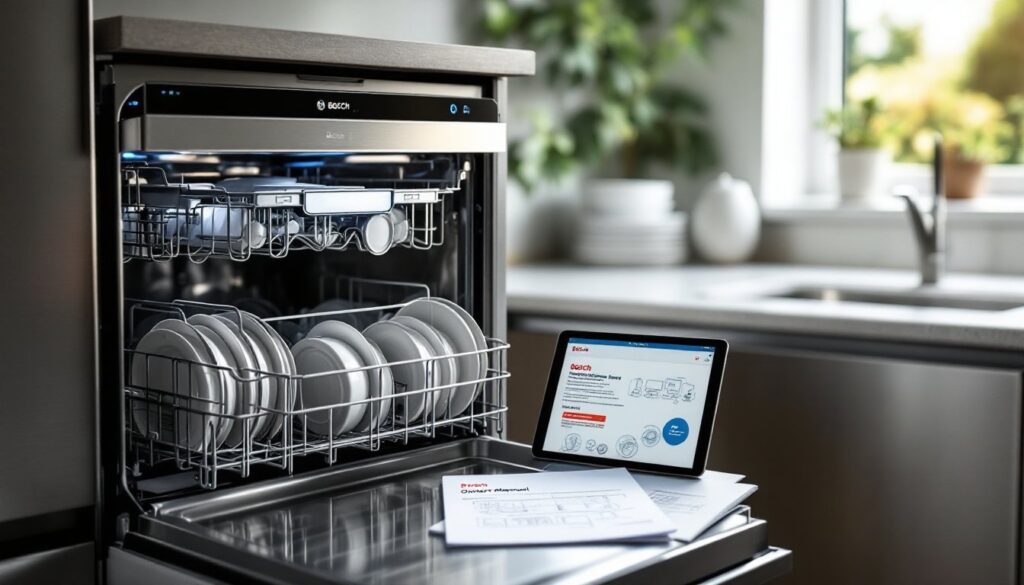
Head to the Bosch Home Appliances support page. You’ll see a search bar asking for your model number. Plug it in, and you’ll get access to the full owner’s manual, installation instructions, and often a separate bosch dishwasher troubleshooting manual pdf with flowcharts for diagnosing issues.
If Bosch’s site is acting up or you want a backup source, try:
- ManualsLib.com: A massive archive of appliance manuals. Search “Bosch dishwasher” plus your model number.
- ApplianceAid.com: Offers manuals and parts diagrams, handy if you’re sourcing a replacement component.
- RetailersNOT: Some retailers like Home Depot or Lowe’s host PDFs in their product support sections if you bought the unit there.
Download the PDF and save it to your phone or print the key pages, error codes, maintenance schedules, and the troubleshooting section. You don’t want to be hunting for Wi-Fi when your dishwasher is mid-meltdown.
Locating Your Model Number
Can’t find your model number? It’s hiding in one of three spots:
- Door jamb sticker: Open the dishwasher door and look along the top edge or the side of the door frame. You’ll see a white or silver label with the model number (starts with “SHE,” “SHX,” “SHP,” or similar) and the serial number (starts with “FD”).
- Interior side panel: Some models print it on the left or right interior wall, near the top rack.
- Original paperwork: If you’ve got the purchase receipt or warranty card, it’s listed there.
The model number is usually formatted like SHE68T55UC/20 or SHPM88Z75N/01. The numbers after the slash indicate production changes, if you can’t find an exact match online, the base model (before the slash) will get you close enough.
Understanding Your Bosch Dishwasher Manual: Key Sections Explained
Bosch manuals aren’t light reading, but they’re organized logically once you know what you’re looking for. Here’s how to navigate the typical structure.
Safety and Installation (pages 1–10): Covers electrical and plumbing requirements, clearance dimensions, and leveling instructions. If your dishwasher isn’t draining properly, double-check the drain hose installation diagram here, improper loops or kinks cause half the drainage issues DIYers face.
Operating Instructions (pages 11–25): Walks through control panel functions, cycle options, and loading tips. Bosch loves their third rack for utensils: the manual shows you how to adjust or remove it if it’s not compatible with your dish height. You’ll also find detergent guidelines here, Bosch recommends powder or gel, not pods, for older models without a dedicated pod dispenser.
Troubleshooting Section (pages 26–35): This is the gold. It’s structured as a symptom-diagnosis-solution table. “Dishes not drying?” Check the rinse aid level and whether you’ve selected a heated dry option. “Water pooling in the bottom?” Clean the filter and check the drain pump for debris.
Testing has shown that Bosch dishwashers, when reviewed by cleaning experts, consistently outperform competitors in quiet operation and wash quality, but only if you’re using the right cycle and detergent for your water hardness.
Maintenance Schedule (pages 36–40): Lists monthly, quarterly, and annual tasks. Most failures stem from skipped maintenance, not mechanical defects.
Warranty and Service (final pages): Contact info, warranty terms, and how to order replacement parts. Bosch sells parts directly through their site or authorized dealers, avoid third-party knockoffs for components like spray arms or filters.
Common Bosch Dishwasher Problems Solved by Your Manual
Here are the issues that send most folks scrambling for the manual, or calling a repair tech unnecessarily.
Error Code E15: This signals water in the base pan, triggering the leak protection system. The manual’s fix: Tilt the dishwasher about 45 degrees to drain the pan, then check for a split hose or loose connection. If it’s a one-time overfill, resetting the unit clears the code.
Error Code E24: Drain blockage. Your manual points you to the filter assembly (twist counterclockwise to remove) and the drain pump. Pull out any food debris, check the sink drain for clogs (Bosch dishwashers share the disposal line if you have one), and ensure the drain hose isn’t kinked.
Cloudy Dishes or White Film: This isn’t a mechanical issue, it’s water hardness. The manual includes a water hardness test strip (or tells you where to get one) and instructions for adjusting the built-in water softener. If your water is above 12 grains per gallon (gpg), you need to add dishwasher salt (yes, it’s different from table salt) to the reservoir under the lower rack.
Dishwasher Won’t Start: Check if the door latch is fully engaged, the child lock is off (press and hold the lock icon for three seconds), and the delayed start isn’t activated. The manual also reminds you to confirm the unit is getting power, Bosch dishwashers often share a circuit with a garbage disposal, and a tripped breaker is a common culprit.
Poor Cleaning on Upper Rack: Usually a water pressure issue. The manual shows you how to remove and inspect the upper spray arm. Mineral deposits clog the spray nozzles over time. Soak it in white vinegar for 30 minutes and clear the holes with a toothpick.
If you’re comparing dishwashers and weighing whether the manual-driven maintenance is worth it, the best dishwashers of 2026 consistently include Bosch models for reliability and efficiency, but they do expect you to read the instructions.
Essential Maintenance Tips from Bosch Manuals
Bosch dishwashers can run 10–15 years if you follow the maintenance schedule in the manual. Skip it, and you’re looking at early failure and costly repairs. Here’s what to prioritize.
Monthly: Clean the Filter Assembly
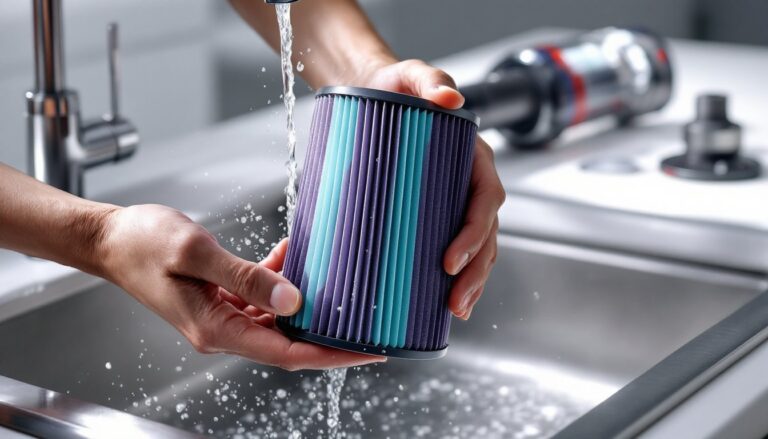
The three-part filter (micro-mesh, coarse filter, and flat fine filter) sits at the bottom of the tub. Twist the cylindrical section counterclockwise, lift it out, and rinse under hot water. Use a soft brush (an old toothbrush works) to scrub away grease and food particles. Bosch recommends doing this every 4 weeks or sooner if you notice reduced cleaning performance.
Quarterly: Run a Cleaning Cycle
Bosch makes a dishwasher cleaner (comes in a bottle you invert in the lower rack), but you can also use a cup of white vinegar placed upright on the top rack. Run the hottest, longest cycle empty. This strips away mineral buildup and grease from the spray arms and interior walls.
Every 6 Months: Check the Spray Arms
Remove both spray arms (they twist or pop off, depending on the model) and inspect the nozzles. Hard water leaves calcium deposits that restrict water flow. Soak in vinegar or a descaling solution if you see white crust.
Annually: Inspect Door Seals and Hinges
The rubber gasket around the door can crack or accumulate mold. Wipe it down with a bleach solution (1 part bleach to 10 parts water) or a mildew remover. Check that the door springs and hinges are tight, if the door feels loose or doesn’t stay open at a 45-degree angle for loading, the manual lists the torque specs and replacement part numbers.
As Needed: Refill Rinse Aid and Salt
Rinse aid isn’t optional, it prevents spotting and speeds drying by reducing surface tension. Bosch dishwashers have an adjustable rinse aid dispenser: the manual shows you how to set it based on your water hardness (usually 3–4 for moderate hardness, 5–6 for hard water). If your model has a salt reservoir (common in European and high-end U.S. models), refill it when the indicator light comes on.
One note: Bosch recommends never using the dishwasher as a garbage disposal. Scrape plates into the trash, but you don’t need to rinse them, modern Bosch models handle food residue just fine, and pre-rinsing actually reduces detergent effectiveness.
Conclusion
Your Bosch dishwasher manual isn’t just a warranty booklet, it’s a roadmap to getting the most out of an appliance you’ll use 200+ times a year. Download the PDF, bookmark the troubleshooting section, and keep it handy. Most issues can be solved in under 10 minutes with the right page open. When the alternative is a $150 service call or prematurely replacing a dishwasher that just needed a filter cleaning, that manual suddenly looks pretty valuable.